Don’t Stop Expandin’
First product-scope consultation for the EU Steel Overcapacity Regulation until end of September and what it signals for industries


The European Commission has launched an 8-week consultation on whether additional categories of steel products should be covered by the EU Steel Overcapacity Regulation that came into force on 1 July 2026. Stakeholders have until 30 September 2026 to submit comments. The European Commission will decide by 31 December 2026 whether to extend the scope to cast iron pipes and hollow profiles, non-alloy and other alloy wire, stainless steel wire, and forged bars. This is the first of many reviews planned under the Regulation. It is likely to attract attention from other industries facing similar challenges.
Background
The Steel Overcapacity Regulation (Regulation (EU) 2026/1384, Regulation) entered into force on 25 June 2026 and has applied since 1 July 2026, replacing the steel safeguard measure that had been in place since 2019 and reached its maximum duration under WTO rules. The new regime introduces significant changes: tariff-free import quotas have been reduced to 18.3 million tonnes across 26 product categories, around 47% lower than in 2024, while imports exceeding the quota are now subject to a 50% duty, up from 25%. Tariff-rate quotas (TRQ) are allocated by country through implementing legislation, with around half reserved for FTA partners and the remainder available to other WTO members. From 1 October 2026, importers must also comply with a new “melt and pour” requirement, identifying the country where the steel was originally melted and poured rather than where it was last processed. Unlike the previous safeguards, the Regulation is an autonomous trade instrument adopted under Article 207(2) TFEU and has no fixed expiry date. The European Commission (Commission) will instead review it periodically.
For more details on the Regulation, please refer to our briefing of 25 June 2026, accessible here: Steel, Still Standing.
The review structure of the Regulation
The Regulation foresees four kinds of review:
(a) Product-scope review
By 31 December 2026, the Commission must decide whether to extend the scope of the Regulation to certain CN codes that are not currently included in Annex I. This review is limited to four product groups (described below) and will not reconsider the 26 product categories already covered.
(b) Broader downstream review
By 30 June 2027, the Commission must assess whether the Regulation should also cover products made of, or containing, significant amounts of steel. This could include, for instance, fabricated structures, tools, hardware, machinery parts, transport equipment and similar downstream steel products. Any such expansion would require a new legislative proposal. Industries already call for broader coverage, including steel-containing goods under CN headings 73–95.
(c) Melt and pour as the basis for quota allocation
By 30 June 2028, the Commission must assess whether quotas should be allocated based on the country where the steel was melted and poured, rather than the country of export. If adopted, this could significantly affect sourcing strategies that rely on processing hubs such as Türkiye, Vietnam or Morocco.
(d) Regular scope and effectiveness reviews
From 30 June 2029 onwards, product-scope reviews will take place every two years and may either expand or reduce coverage. Separate effectiveness reviews will be conducted every three years. These recurring reviews mean that the Regulation will evolve over time rather than remain a one-off trade defence measure.
In addition, the Commission can adjust TRQ volumes by delegated act, provided the total annual volume remains between 14.4 million and 22.2 million tonnes.
Ongoing consultation to expand the product scope
On 30 July 2026, the Commission launched a targeted consultation to gather stakeholder views and information on which product groups should fall within the scope. This consultation is part of the first of product scope review as described above and will remain open for a period of 8 weeks, from 30 July 2026 to 30 September 2026, 23:59 CEST.
The Regulation lists the four product groups that must be assessed in this first review:
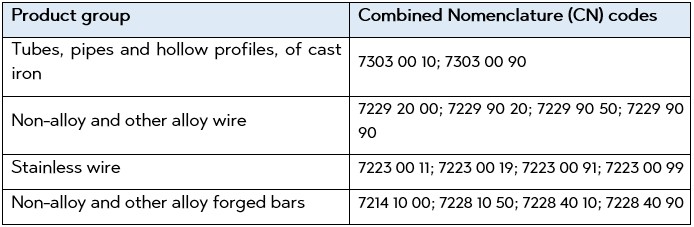
Submission in the context of the present consultation can be made by completing an EU survey available here, which could be accessed via EU Login.
Who should engage and what do submit?
The consultation is open to EU producers, downstream users, service centres, traders, importers, industry associations, chambers of commerce and non-EU exporters with a commercial interest in the affected CN codes. Engagement will be important: for instance, if downstream stakeholders do not contribute, the record may be dominated by producer submissions, making an extension more likely.
If these CN codes appear on your import declarations, mill certificates or supplier invoices, you are directly in scope. If, on the other hand, they appear in your production inputs or service-centre offering, the impact may be indirect but still significant. The current consultation is the earliest opportunity for affected stakeholders to influence whether the scope should be extended.
Submissions should focus on four types of evidence: import volumes, prices and trends for the relevant CN codes over the last three to five years; the availability of EU-made alternatives for downstream users; any signs of circumvention through wire, forged bars or cast iron products; and the competitiveness of EU producers, including jobs and decarbonisation. Evidence backed by import data, price comparisons and end-use information will carry more weight than anecdotal submissions.
Our team would be pleased to assist with preparing and filing your submission.
The wider significance of overcapacity
The Regulation marks a shift in EU trade defence policy. It creates a permanent, autonomous tool to address structural overcapacity, rather than a temporary safeguard measure based on serious injury caused by increase in imports and unforeseen developments. This shift was partly a response to the expiry of the steel safeguard in June 2026. But its logic may reach beyond steel, as overcapacity, foreign subsidies, state-led capacity growth and trade diversion also affect other sectors.
Over the next two to three years, the Commission may consider similar tools for other industries, where there is clear evidence of structural overcapacity outside the EU, trade diversion into the EU market, and negative price or volume effects on EU producers. We are already discussing these issues with clients in several sectors. If your industry faces similar pressures, we would be pleased to discuss what evidence would be needed and how best to engage with the Commission, Member States and the European Parliament.
BLOMSTEIN will closely monitor further developments and keep you informed. If you have any questions on the topic, Leonard von Rummel and Uğur Can Hekim and the entire team is ready to assist you.