Defeating the Final Boss
Gaming After the Gatekeepers


Mobile game developers have long had to pay Apple and Google a 30% commission for every transaction. Under the Digital Markets Act (DMA), this is no longer the case. The DMA as well as the German equivalent (section 19a Act against Restraints of Competition (ARC)) are the weapon that lets Mario defeat Bowser. The aim of the DMA is to hold tech giants accountable regarding how they operate their platforms and to empower smaller players. For video game studios, publishers and consumers, the DMA aims to reduce restrictions, create greater control and, ultimately, a better user experience. Here is what gaming companies are now able to do under the DMA.
Speed run through the DMA and other rules for digital markets
DMA
The DMA is part of the EU’s strategy to regain digital autonomy. It aims to curb disproportionate influence of so-called ‘gatekeepers’ that control the essential entry points to the internet or, to use the wording of the DMA, provide ‘core platform services’.
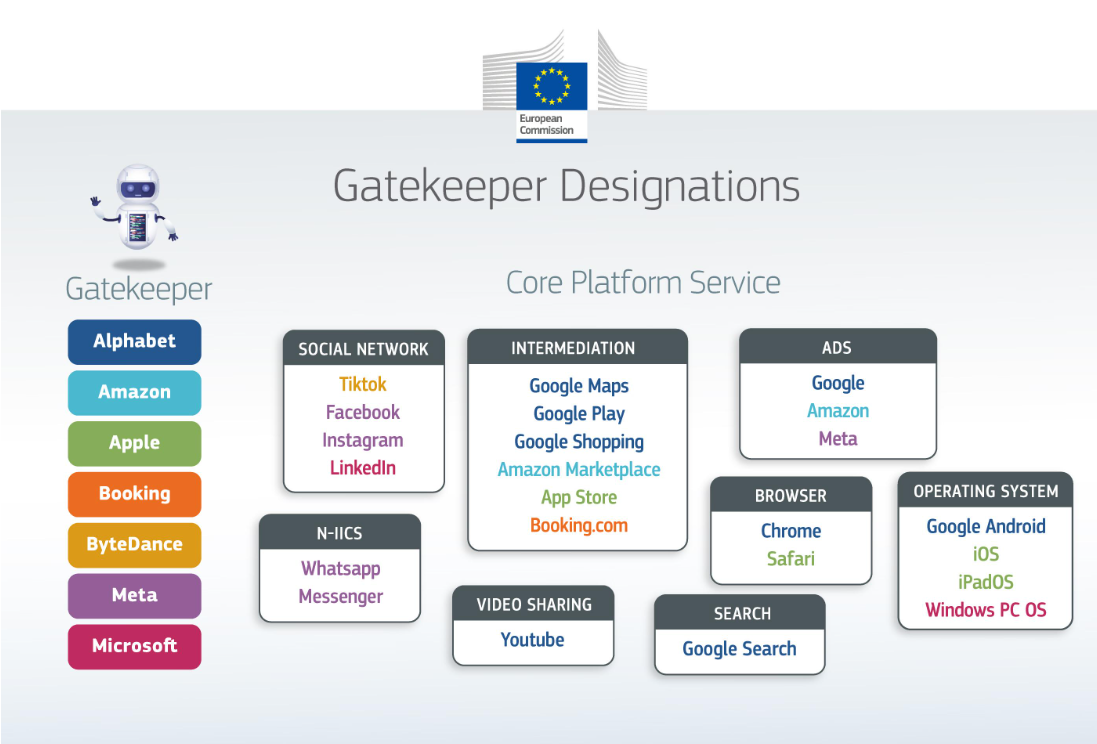
*Source: European Commission
Once a company has been designated as a gatekeeper for one of these services, the law sets out dos and don’ts for the operation of the core platform services. For example, gatekeepers must enable the interoperability of their services and may no longer treat their own services and products more favourably in ranking than similar services or products offered by third parties on the gatekeeper’s platform (‘self-preferencing’). Gatekeepers are also prohibited from linking user data across different services without explicit consent or from preventing commercial users from advertising their offerings outside the gatekeeper’s platform. The aim of these measures is to create scope for innovation for smaller companies and to prevent consumers from being trapped in closed ecosystems by unfair practices or artificially high prices.
Enforcement is already well underway and fines can reach 10% of a gatekeeper’s global turnover or even 20% for repeat offenders. The Commission achieved noticeable results through regulatory dialogues (e.g. Meta’s concessions towards the choice screen or Google's improvements towards app store registration as well as side loading) but has also not shied away from handing out landmark fines to Apple and Meta totalling EUR 700 million for non-compliance. However, enforcement does not have to go through Brussels only. In a groundbreaking decision, the Mainz district court ruled that Google infringed the DMA by effectively forcing users into its own Gmail ecosystem during device setup. This case demonstrates that private companies can also successfully challenge the tech giants directly in national courts.
Section 19a ARC
Not only Europe is seeking to rein in Big Tech. Germany operates a powerful parallel system under section 19a ARC with distinct features. The first major distinction is its applicability. While the DMA is strictly limited to designated gatekeepers providing specific pre-defined core platform services, the German rules cast a wider net. Section 19a applies to any company found to have ‘outstanding cross-market significance for competition’. This way, the German rules may adapt more easily to innovative new business models. The methodology also differs significantly. The DMA relies on self-executing rules – if a gatekeeper meets the criteria, the dos and don’ts apply automatically. In contrast, Section 19a is a two-step process: the Federal Cartel Office (FCO) must first formally designate a company and then issue a specific order to prohibit certain behaviour. This makes the German approach more discretionary and flexible, but also less predictable. If a designated company then infringes against the FCO’s order, it can expect fines up to 10% of its global turnover. Finally, there is a difference regarding the possible defence. If a gatekeeper breaches a DMA rule, it is not possible to justify its actions with the efficiency defence. Section 19a, however, provides a small window for companies to objectively justify their conduct, which may make private enforcement more difficult.
How do the DMA and section 19a ARC interact?
Though the DMA takes precedence over national German law, section 19a has not lost its significance. As section 19a is more flexible than its EU counterpart, it can apply when a gatekeeper extends its power to adjacent or follow-on markets (e.g. VR/AR or gaming hardware; AI), even before they are officially designated as core platform services under the DMA. As such, the FCO examined Meta’s practice of linking the use of the VR-headset ‘Quest 2 VR’ to the Meta ecosystem under section 19a (users needed a Facebook or Instagram account in order to be able to use the VR-headset). In 2022, Meta ultimately responded to the FCO’s concerns by allowing users to use the VR-headset without a Facebook/Instagram account. In the same year, the FCO initiated the ongoing proceedings under section 19a against Apple’s tracking rules for third-party apps which are suspected to give rise to self-preferencing concerns.
What has changed for gaming companies in the EU?
From a gaming perspective, the DMA is most relevant for mobile gaming. Both Apple and Google are designated gatekeepers and their respective app stores (App Store and Play Store), as well as mobile operating systems (iOS/iPadOS and Google Android) are designated core platform services.
App distribution
The DMA forces gatekeepers such as Apple and Google to allow alternative app stores and sideloading (i.e. direct downloads from a source outside of an app store) on mobile devices in the EU. In practice, this means two things: First, game developers must be able to create their own app stores and establish them within Apple’s App Store or Google’s Play Store. When users browse the App Store (Apple) or the Play Store (Google), they would then be able to see and download games that are available exclusively on third-party app stores directly from within the App Store or Play Store. Second, game developers must be able to create their own app stores and make them available for download on iOS and Android. For example, Epic Games now operates the Epic Games Store on iOS in the EU and on Android worldwide. Users would then be able to have e.g. the Epic Games Store app as well as the native App Store or Play Store on their device. Furthermore, apps can also be distributed from a webstore directly. For example, Supercell opened its own web store which allows users to download games from the website, as opposed to an app store.
Anti-steering and alternative payment systems
Another key feature of the DMA is that gatekeepers must allow game developers to use third-party payment systems instead of the mandatory App Store or Google Play systems. This way, game developers are able to avoid the app store commissions and increase their profit margins. This also applies to in-game payments. For example, Epic Games would now be able to use a billing system of its choice in order to complete in-game purchases rather than being forced to use Apple’s or Google’s own (likely more expensive) payment system. Moreover, ‘anti-steering’ requires gatekeepers to allow game developers to ‘steer’ or to lead its customers to these third-party offers and to facilitate these transactions. For example, Apple must allow Epic Games to ‘steer’ its users in-app and free of charge to offers on the Epic Games website.
Data access and protection
The DMA tackles data access and protection in a number of ways. First, gatekeepers are no longer allowed to use non-public information about game developers obtained via its core platform services for its own competitive advantage. For example, Apple may no longer use data on Epic Games collected through iOS to its advantage. Second, the DMA requires ‘data portability’, which means that, upon user request, gatekeepers must facilitate the free and effective transfer of user data to another ecosystem. This way, the hurdles for users to switch to another ecosystem are minimal and gamers can choose to switch at any time without losing their high scores. Lastly, the DMA also requires gatekeepers to provide free, fair and real-time access to some of its data to businesses and users. These data include analytics on how users use their services and can be valuable information for game developers.
Interoperability
The DMA also addresses interoperability with and access to hard- and software features controlled by gatekeepers’ operating systems. Interoperability allows game developers to seamlessly integrate their games into the respective mobile operating system, which allows for a smoother user experience. Game developers may now submit a request for interoperability with a gatekeeper’s operating system. Both Apple and Google have introduced tools where game developers may submit such requests. The eligibility of a developer’s request is assessed by the respective gatekeeper itself on a case-by-case basis according to a set of legal criteria and within a specified timeframe (20 days), but can ultimately be denied. If eligibility has been established, the gatekeeper will develop a solution for interoperability within a specified timeframe.
DMA and section 19a ARC – a game-changer?
The DMA and its German counterpart are a big win for mobile game developers in the EU and represent a power shift in the digital gaming landscape. The ability to distribute through alternative app stores and to integrate third-party payment systems means the era of the mandatory 30% platform commission is over, at least in principle. Having the rules on paper is one thing, but getting platforms to comply is another. Interoperability requests are assessed (and can be refused) by gatekeepers themselves. Steering rights exist on paper, but their limits are being fought over in Brussels and in national courts. Thanks to the Mainz decision, studios need no longer wait for the Commission to act, but can now take their case directly to a national court.
For developers, the question is no longer whether platforms must open up. It is a matter of choosing the most effective lever and potentially filing a regulatory complaint with the Commission, or taking the case to a national court.
BLOMSTEIN will closely monitor further developments and keep you informed. If you have any questions on European Gaming Regulation or the DMA, Leonard von Rummel, Anna Blume Huttenlauch, Philipp Trube and the entire team are ready to assist you.