Industrial Policy through FDI Screening
FDI Screening under proposed Industrial Accelerator Act


The EU is facing increasing pressure from global instability and a weakening rules-based order. The “Industrial Accelerator Act” (IAA), for which the Commission recently unveiled its proposal (the Proposal), is designed to help navigate these challenges. The Proposal sets the target of raising the share of the manufacturing industry in the EU’s gross domestic product to at least 20 % by 2035. This aim shall be achieved mainly by two mechanisms: a framework for Foreign Direct Investment (FDI) screening in certain sensitive sectors and “Buy European” requirements for public procurement procedures and subsidies on the other hand. While this briefing focuses on the FDI aspects of the Proposal, its “Buy European” elements are discussed separately.
The Scope of FDI Screening under the Proposal
The FDI provisions of the Proposal supplement the framework established by the revised FDI Screening Regulation. While the latter focuses on FDI screening through the lens of national security and public order, the IAA’s FDI screening has a clear industrial policy goal: it aims to make sure that FDIs come along with tangible benefits to the EU. Under the Proposal, FDIs shall be subject to control if they cumulatively meet four requirements:
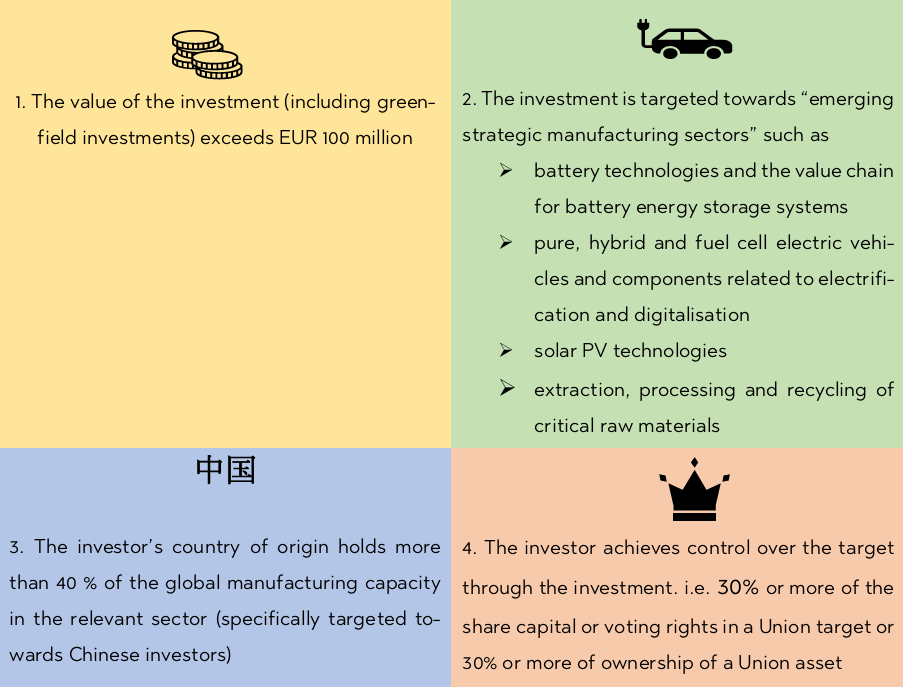
Third countries with which the Union has concluded FTAs or economic partnerships are exempt from these provisions to the extent that the respective agreements include relevant commitments with regard to FDIs, including investments by the EU subsidiaries of the investors. Exempt are also portfolio investments as well as investments targeted at providing services.
Approval Criteria
When it comes to the criteria according to which the (dis)approval of the investment shall be determined, the Proposal differentiates between investments made directly by the foreign investor on the one hand and those made within the Union by a foreign investor’s subsidiary. Investments made directly by the foreign investor need to meet at least four of the six requirements laid down in Article 18 para. 2 of the Proposal. Specifically, the foreign investor shall alternatively
not own or control more than 49% of the investment target,
establish a joint venture with at least one Union entity to undertake the investment and not own or control more than 49% of any of the Union entities participating in the joint venture
agree with the Union target or asset on the licensing of his intellectual property rights and know-how in a way beneficial for the Union target or asset,
redirect at least 1 % of the gross annual revenue of the Union target or asset towards Union-based R & D,
make sure that at least half of the workforce employed in the context of the investment across all levels of the workforce are Union workers, and/or
develop and publish a strategy to prioritise Union-based value chains and attempts to source at least 30 % of inputs from within the EU.
As regards investments made within the Union by a foreign investor’s subsidiary, National Investment Authorities (NIAs) enjoy comparatively greater discretion. There is no minimum number of conditions to be fulfilled, but the competent NIAs may apply some or all of the abovementioned conditions if this is indispensable to achieve the objectives of the Proposal, in particular if circumvention of the framework by the foreign investor shall be prevented and no adequate alternative measures are available.
Screening Procedure
Review of FDIs in the IAA context is principally carried out by the Member States, which shall designate respective NIAs. The Proposal does, however, grant the Commission considerable leeway to take over the screening process itself.
The screening procedure is carried out in several subsequent steps. First of all, any foreign investor who envisages an (greenfield) investment falling within the scope and which would result in control over the Union target or asset is obliged to notify the NIA of the Member State where the target or asset is located. If the respective NIA deems the notification to be admissible, it transmits the notification to the Commission. The latter then issues an opinion which, however, assesses not only the admissibility, but additionally whether or not the investment should be approved. The NIA is only allowed to finally decide the case once it has received the opinion or if the Commission fails to meet the applicable deadline of 30 days for delivering the opinion. If a NIA's decision differs from the Commission's opinion, the NIA must carry out a more detailed assessment and explain how it has taken the Commission's opinion into account.
While this still leaves the final decision to the NIA, with the Commission “only” exerting soft power through a “comply or explain” mechanism, the Proposal also provides for certain constellations in which the Commission can itself undertake the actual FDI screening. First, the Commission may do so at the request of a NIA. Second, and more remarkable, are those cases in which the Commission shall be granted a right of initiative. According to the Proposal, this shall be the case for FDIs with a value exceeding EUR 1 billion on the one hand, and “where the foreign direct investment has the potential to significantly impact added value creation in the Union market” on the other hand. The cases of significant impact on added value creation, such as “particular strategic importance for the internal market” and the danger of supply chain disruptions, are listed exhaustively. Finally, the Proposal assigns a decision-making competence to the Commission if there is disagreement between Member States in multi-jurisdictional cases. Such disagreement can result from the fact that in cases where the relevant Union target or asset is located in more than one Member State, notifications have to be sent to all competent NIAs. The Member States concerned need to reach consensus which of the conditions laid down in Article 18 para. 2 of the Proposal shall be applied. In case they do not reach consensus, the Proposal grants the Commission the respective decision-making competence.
NIAs are entitled to establish penalties against foreign investors in case of non-compliance with the regulatory framework. If the foreign investor does not properly notify the planned investment, the competent NIA shall establish a penalty of no less than 5 % of the average daily aggregate turnover of the foreign investor or, if the foreign investor is a private person, a penalty payment of at least 5 % of the investment value.
What next?
The political tug-of-war over the Commission proposal must not obscure that by now it is no more than that – a proposal. With the Council and Parliament yet to have their say, intense political negotiations likely lie ahead. Experience from past legislative procedures suggests that the proposal will almost certainly be significantly amended before adoption. In particular, it is to be expected that the Council will oppose the central role the Commission has suggested to assign itself in the context of FDI screening. Already with respect to the revision of the FDI Screening Regulation, the respective roles of the Commission outlined by the Commission Proposal on the one hand and the Council’s mandate for negotiations on the other hand diverged greatly. Furthermore, the Proposal entails some blank spaces which may be filled in the course of the upcoming negotiations, such as the specific procedure under which the Commission may be granted decision-making competence in case of disagreement in multi-jurisdictional cases, as the Proposal leaves open who is competent to authoritatively determine a case of “disagreement”.
BLOMSTEIN will closely monitor further developments and keep you informed. If you have any questions on the Industrial Accelerator Act, Leonard von Rummel and the entire team is ready to assist you.